Innovativer Hersteller von Heizprodukten aus Honighals und MI
Innovativer Hersteller von Heizprodukten aus Honighals und MI
Produktdetails:
Zahlung und Versand AGB:
|
| Eigentum: | Korrosionsschutz | Größe in mm*mm: | 1200*1200 |
|---|---|---|---|
| Oberflächenbehandelt: | Passiviert | Anwendung: | Autosicherheit |
| Produktname: | Waben-Energieabsorber | Dicke: | Normale Dicke 20, 25 mm oder individuell |
Energy-Absorbing Aluminum Honeycomb Core Lightweight High-Performance Cushioning Material
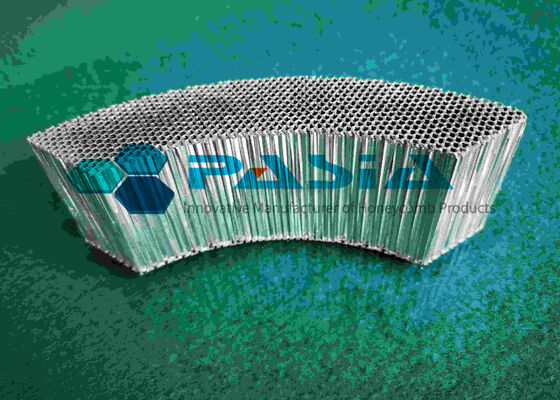
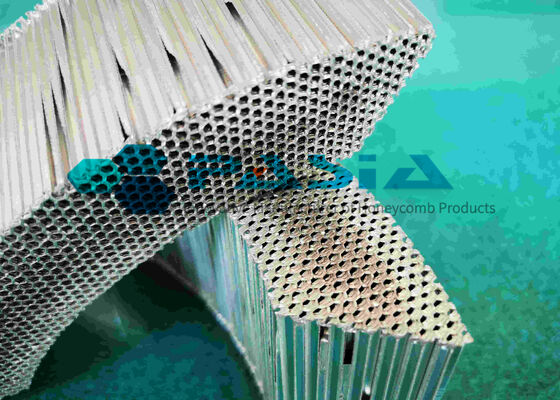
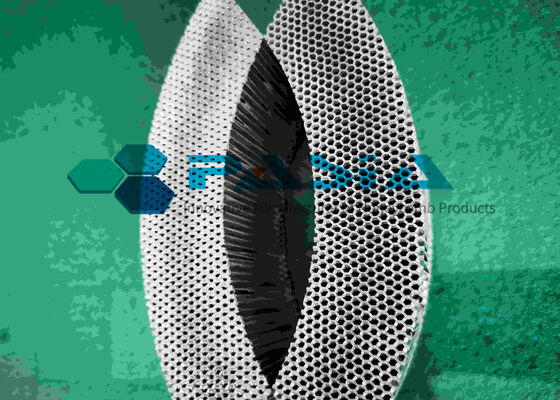
Energy-Absorbing Aluminum Honeycomb Core Lightweight High-Performance Cushioning Material is a lightweight porous material made from aluminum alloy foil, which is expanded into a regular hexagonal cellular structure. The cell geometry is a regular hexagon, with cells connected to each other to form a three-dimensional network resembling a natural beehive. As the core layer of a sandwich structure, it is widely used in passive safety applications such as rail transportation, aerospace, and automotive crash protection, where it absorbs and dissipates impact energy during accidental collisions.
Structurally, it resembles the load transfer mechanism of an I‑beam: the upper and lower face sheets act as the flanges, primarily carrying in‑plane tensile/compressive and shear stresses; the aluminum honeycomb core acts as the web, primarily carrying transverse shear stresses. Under the same mass, the bending stiffness of an aluminum honeycomb sandwich panel is approximately 5 times that of an ordinary aluminum alloy panel, demonstrating outstanding structural efficiency.
Among its many applications, Truck‑Mounted Attenuators (TMAs) are a typical example – they are installed at the rear of highway maintenance and construction vehicles. When a rear‑end collision occurs, the aluminum honeycomb core absorbs most of the impact energy through crushing deformation, thereby protecting the occupants of both vehicles and the workers ahead. TMAs have been deployed on highways in many Chinese provinces.
Energy Absorption Principle and Mechanical Behavior
The energy absorption mechanism of an aluminum honeycomb core is essentially the dissipation of impact kinetic energy through plastic deformation of the material. Under dynamic compression, the stress‑strain curve exhibits the typical three‑stage behavior of porous materials:
Stage 1 – Elastic region: At the beginning of compression, the cell walls undergo elastic bending deformation, and the stress increases linearly with strain.
Stage 2 – Plateau region: After reaching the yield point, the cell walls undergo local buckling and plastic collapse, and the stress remains at a relatively stable “plateau stress” level. The plastic yield plateau strain of an aluminum honeycomb core is generally greater than 65%, meaning it can absorb energy steadily over a long compression stroke. This is the core stage for efficient energy absorption.
Stage 3 – Densification region: When the compression reaches a certain level, the cells are completely crushed, the material densifies, and the stress rises sharply.
Experimental studies show that under low‑velocity impact, the energy absorption capacity of an aluminum honeycomb core is about 1.33 times that under quasi‑static compression, indicating better dynamic performance. The plateau strain increases with the ratio of cell height to cell side length, and tends to stabilise when H/d > 3.46.
Key Specifications and Technical Parameters
The performance of an energy‑absorbing aluminum honeycomb core is mainly determined by three geometric parameters: foil thickness, cell side length, and core height. Among these, the ratio θ = t/b (foil thickness to cell side length) is the core indicator – the larger the θ, the better the energy absorption performance.
Common Materials and Specifications
| Parameter Category | Specification Range | Typical Values |
| Alloy grade | AA3003, AA5052, AA5056 | 3003 H18 / 5052 H24 |
| Foil thickness | 0.015–0.15 mm | 0.04–0.06 mm |
| Cell side length | 0.4–10 mm | 1.0–5.0 mm |
| Core height | 2–300 mm | 10–200 mm |
| Density range | 30–300 kg/m³ | 30–80 kg/m³ (energy‑absorbing type) |
| Compressive plateau stress | 1–30 MPa (density dependent) |
3–15 MPa
|
| Volumetric specific energy absorption(SEA_v) | 3.32–5.03 MJ/m³ |
4.0 MJ/m³
|
Pasia Honeycomb Energy Absorbers is normally supplied at a status of machine finished to required part after pre-crush from which the first few millimeters of the core should have already been crushed and in so doing attenuating the initial force peak. The initial force peak is high but for a short duration, after which the force required to displace the honeycomb quickly reduces and stays at a constant level throughout the event. Energy Absorbers can be developed for bespoke project specifications, or for serial production for a wide range of applications including:
Typical Application Scenarios
Application Field Specific Use Core Advantage
Rail transportation High‑speed train / metro front anti‑climbers, energy absorber blocks Stable force output, high specific energy absorption, controllable deformation mode
Automotive safety Frontal crash barriers, truck‑mounted attenuators (TMA) Lightweight, controllable barrier stiffness
Aerospace Aircraft floor panels, cargo liners, landing gear cushions High strength‑to‑weight ratio, high energy absorption efficiency
Marine / naval Ship hulls, naval bulkhead protection Good impact resistance, controllable deformation mode
Military blast protection Blast containment vessels, blast‑proof sandwich structures Good deformability, excellent cushioning and energy absorption
Testing Data
| Serial | Sample Name | Width(mm) | Length(mm) | Maximum Loading(N) | Crushing Strength(MPa) |
| Aluminum Honeycomb Core | 49.0 | 48.0 | 27487.99 | 9.70 | |
| Aluminum Honeycomb Core | 50.0 | 48.0 | 31790.69 | 9.57 | |
| Aluminum Honeycomb Core | 48.0 | 48.0 | 24778.45 | 9.59 | |
| Aluminum Honeycomb Core | 48.0 | 50.0 | 30205.60 | 9.52 | |
| Max Value | 50.0 | 50.0 | 31790.69 | 9.70 | |
| Min Value | 48.0 | 48.0 | 24778.45 | 9.52 | |
| X-bar | 48.8 | 48.5 | 28565.68 | 9.60 |
Testing Curve: